

Jul 29, 2026
Scaling Beyond Limits: How Integrated Ecosystems Power Modern Enterprises
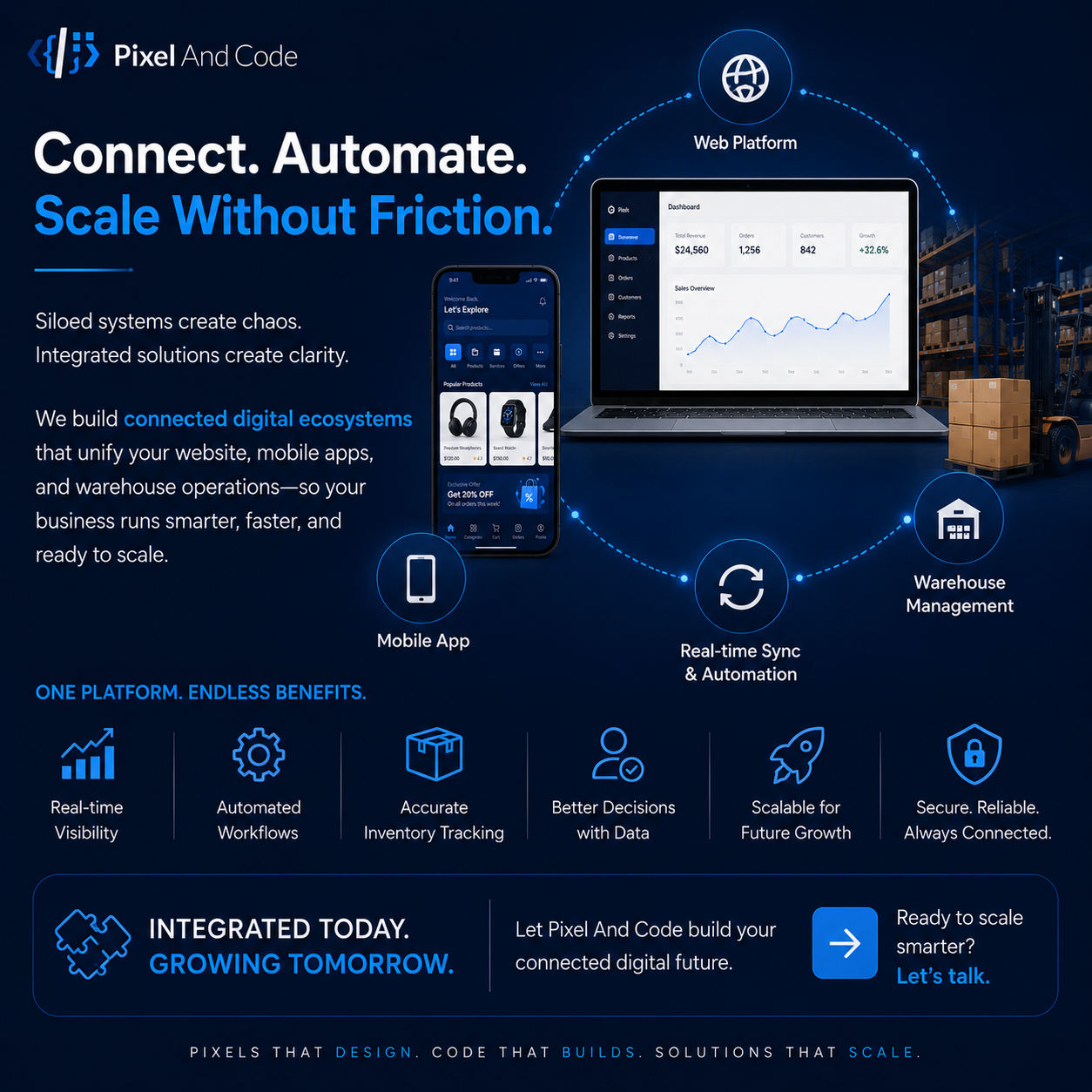
When a business relies on disconnected tools—a random invoicing app here, a manual spreadsheet there, and a basic website that doesn't talk to inventory—growth eventually stalls. To scale efficiently, your entire business needs to function as a single, synchronized ecosystem.
True digital transformation isn't just about adopting technology; it's about connecting every dot so your website, mobile apps, warehouse logistics, and tracking systems work together effortlessly.
Key Pillars of a Fully Integrated Digital Ecosystem
1. A Unified Digital Presence
Your customer-facing website and mobile applications should serve as a seamless extension of your brand. When orders, inquiries, or bids placed on your app feed directly into your central database, administrative friction disappears.
2. End-to-End Operational Visibility
From the moment an order is placed to its fulfillment in the warehouse, every step should be logged and tracked automatically. Real-time updates eliminate bottlenecks, reduce human error, and keep both management and clients fully informed.
3. Data-Backed Agility
When all your business metrics—sales, inventory levels, user activity, and logistics—live on one centralized platform, decision-making changes from guesswork to precision strategy. You can spot trends, optimize stock, and pivot operations instantly.
4. Future-Proof Scalability
Building custom web and mobile architectures ensures your tech stack grows alongside your business. You won't outgrow rigid third-party limitations; instead, your systems adapt dynamically to your expanding operational needs.
The Bottom Line
Eliminating operational silos and embracing full digitalization saves time, slashes overhead, and unlocks massive growth potential.
At Pixel and Code, we architect custom web platforms, mobile applications, and integrated backend systems designed to take your business from manual chaos to automated efficiency.